A buyer under contract on a house near downtown or the east side will often ask their agent one question about radon: what does Indiana actually require here? The honest answer surprises most people. It requires almost nothing beyond what the seller happens to already know, and no state law forces anyone to find out more before the sale closes.
That gap matters more in Monroe County than in most places, because the ground underneath Bloomington makes radon levels genuinely unpredictable from one house to the next. A buyer who treats a clean disclosure form, or a favorable zone map, as proof of anything is reading a document that was never designed to answer the question they're asking.
What Indiana's Disclosure Form Actually Asks For
Indiana Code 32-21-5 requires sellers of most one- to four-unit residential properties to complete a Seller's Residential Real Estate Sales Disclosure, commonly called Form 46234, and deliver it before accepting a buyer's offer. The form asks sellers to report known hazardous conditions, including radon gas, mold, asbestos, and similar issues.
The word doing the work in that sentence is known. Indiana asks sellers for their current actual knowledge on the date they complete the form, not the results of an inspection they haven't ordered. A law firm that regularly guides Monroe County sellers through the disclosure process describes actual knowledge as exactly what it sounds like: what the seller genuinely knows, nothing more. There is no requirement to test before listing, and selling a home as-is does not remove the disclosure obligation, but it also does not create a testing one.
There is a second wrinkle that trips up more sellers than it should. Indiana has two different documents that both get called a sales disclosure form. The IC 32-21-5 condition disclosure covers radon and other known defects and must reach the buyer before an offer is accepted. A separate document, Form 46021, is filed with the county auditor at closing for property tax assessment purposes and has nothing to do with radon at all. Confusing the two is a common mistake in Indiana closings, and only one of them is the form a buyer should actually be reading for environmental history.
What people assume | What Indiana law actually does |
|---|---|
Sellers must test for radon before listing | Sellers disclose only what they already know, with no testing requirement |
A broker must hand buyers a radon warning packet | No such requirement exists today, and a bill to add one has not received a hearing in two legislative sessions |
A favorable zone designation means the house is low risk | Zone maps are county-level averages that can miss the swings seen from one lot to the next |
Landlords must disclose or fix known radon issues for tenants | Bloomington Housing and Neighborhood Development has confirmed no such tenant protection currently exists |
The Bill That Would Have Closed This Gap Has Failed to Get a Hearing Twice
Lawmakers have tried to change this. Senate Bill 61, introduced in the 2026 session, would have required a broker representing a seller to provide a written radon warning statement before a purchase agreement is signed, along with any known test records and a state-published radon guide. The Hoosier Environmental Council's tracking of the bill notes that an identical version was introduced in 2025 and never received a hearing, and that SB 61 met the same fate in 2026 with no clear path forward in that session.
For a buyer or seller working a deal right now, that history means one thing: the broker-warning requirement some people assume already exists in Indiana simply does not, and there is no indication it will exist soon. Whatever protection a transaction gets on radon has to come from the parties themselves, not from a statute.
Why a Zone Map Won't Tell You Much About Your House
Monroe County sits in south-central Indiana's limestone belt, and that geology is the reason radon behaves so inconsistently here. A directory of licensed Indiana radon professionals notes that Monroe County carries an EPA Zone 2 designation, moderate risk on paper, but that the county's karst and cave-forming bedrock create a different radon environment than the glaciated soils of northern Indiana counties, with some homes built on till-covered ridges exceeding the 4 pCi/L action level even though the county average sits lower.
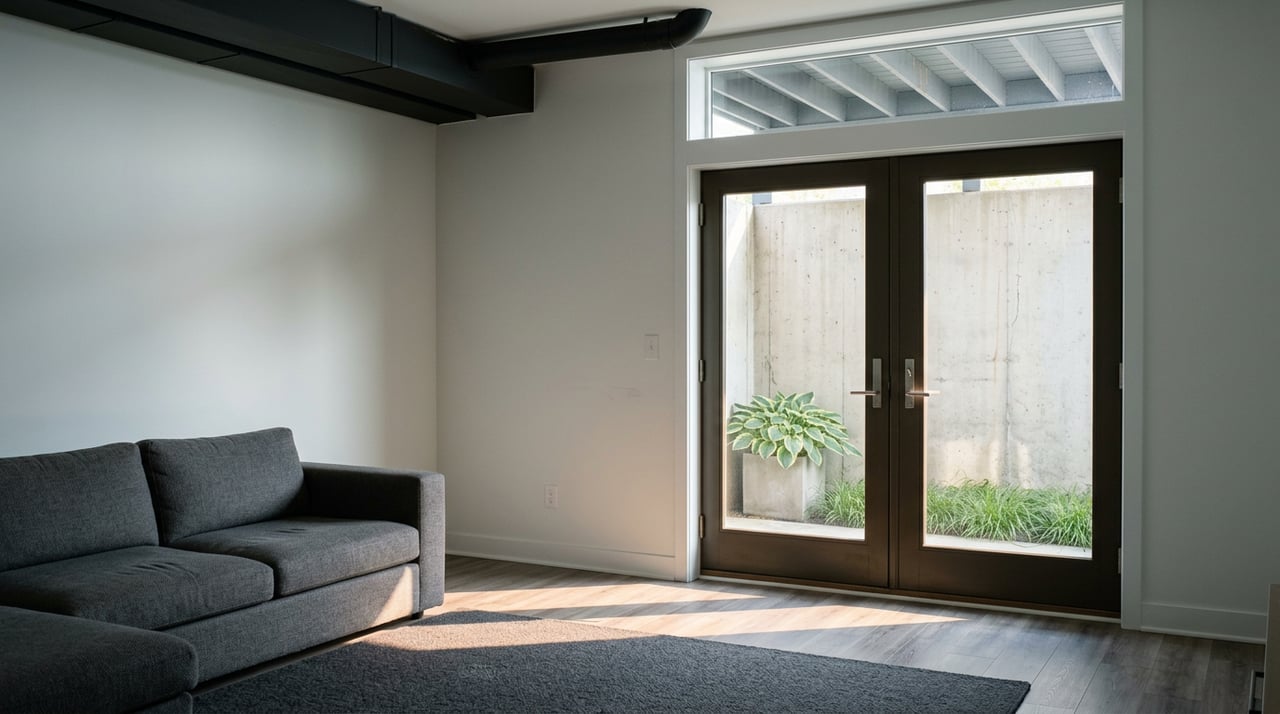
That same source points out that Bloomington's hilly terrain means a lot of homes have walkout basements and partially below-grade living space with direct soil-gas contact, and that the county's near-campus older housing stock, much of it never tested, is a particular blind spot for the relocating faculty and graduate students who buy there each year.
The Indiana Daily Student's 2024 look at Monroe County's radon data made the local variability concrete. A local radon professional interviewed for the piece described readings as high as 100 pCi/L on Bloomington's northwest side, an area near the region's limestone quarries, and recalled one house testing around 50 pCi/L while a neighbor 40 yards away came in at 4 pCi/L. Readings can shift with moisture, wind, and even seismic activity, and they can change year to year in the same house.
That is the reason a neighbor's clean test or a favorable zone map tells a buyer almost nothing about the specific house they're under contract on.
"There really are no tenant rights in regards to the radon."
That line comes from Anna Killion-Hanson, director of Bloomington Housing and Neighborhood Development, describing the current gap for renters. It applies just as directly to the buy-side conversation: without a state testing mandate, the only reliable signal is a current test of the specific house, run recently, by someone qualified to run it.
The Free Local Data Most Buyers Never Check
Monroe County has already built the tool that closes part of this gap, and few buyers use it. The Monroe County Health Department maintains an interactive radon dashboard mapping tests it has conducted and currently offers free radon test kits to Monroe County homeowners. Any buyer or seller can request a kit through the department's environmental health staff before making a decision that hinges on the answer.
Because readings vary so much within a few hundred feet, a test from the county dashboard for a similar house down the street is a starting point for curiosity, not a substitute for testing the actual property in question.
Bringing This to the Closing Table
For a buyer or seller working through a Monroe County contract, the practical moves are straightforward once the legal gap is clear.
- Request a current radon test on the specific house, not a review of the disclosure form's radon checkbox alone. A clean form only reflects what the seller knew, not what a test would show.
- If the seller has prior test results or an existing mitigation system, ask for the documentation. Indiana law requires disclosure of known test records and mitigation history, and a seller with a documented system in place has already done work that should factor into the negotiation.
- Build a radon contingency into the purchase agreement with a defined action level, most commonly the EPA's 4 pCi/L threshold, and a clear path for who pays for mitigation if the number comes back above it.
- Do not assume a broker is required to hand over a warning statement or a state radon guide. Ask directly, and treat the answer as one more piece of the seller's actual knowledge rather than a legal guarantee.
For Landlords Weighing a Near-Campus Purchase
The absence of a tenant-facing radon rule is worth weighing carefully for anyone buying a rental property near campus, a common move for investors drawn to Indiana University's rotating population of students and visiting faculty. Killion-Hanson's comment reflects the current reality: a landlord who finds elevated radon in a rental unit has no legal obligation to disclose it to tenants or to act on it. That is a liability question as much as a habitability one, and it deserves its own conversation with an attorney before closing, separate from the standard purchase-side disclosure review.
FAQ
Does Indiana require a radon test before a home can be sold? No. Sellers must disclose their actual knowledge of radon on Form 46234, but no state law requires testing before a listing or a sale.
Is there a law requiring my agent to give me a radon warning packet in Indiana? Not currently. A bill that would have added that requirement, Senate Bill 61, did not receive a hearing in either the 2025 or 2026 legislative sessions.
If a zone map shows Monroe County as lower risk, does that mean my specific house is fine? Not reliably. County-level zone data can miss the swings researchers have documented within Monroe County, including neighboring homes testing tens of pCi/L apart.
Are landlords required to test rental properties for radon in Bloomington? No. Bloomington Housing and Neighborhood Development has confirmed there is currently no tenant protection requiring landlords to test, disclose, or mitigate radon in a rental unit.
Radon is one of the quieter details in a Monroe County transaction, and it is exactly the kind of thing a good local agent should be flagging before it becomes a last-minute surprise at the inspection table. If you're preparing to buy or list in Bloomington and want a straight answer about what your specific contract should and shouldn't assume, the team at Realty Professionals can walk through it with you.